
1. INTRODUCTION
Angiosperms are fundamental to the majority of terrestrial ecosystems and human sustenance due to the food, pharmaceuticals, and raw materials they supply. Biodiversity of angiosperms in any geographical region has an immense influence on the geographical regions. Biodiversity, an abbreviation for biological diversity, refers to the total quantity, variety, and variability of living creatures, together with the diversity of their ecosystems [1]. Biological diversity refers to the variety of living creatures, encompassing diversity among species, between species, and within ecosystems, as well as the ecological processes in which they are involved [2]. Biodiversity is significantly dependent on several topographical and climatic factors. Several workers reported that riverine regions of West Bengal are rich in plant biodiversity [3]. Biodiversity has lately become a matter of scientific and political significance, especially due to rising extinction rates attributed to human activities [4]. The significance of biodiversity has been widely acknowledged in recent decades, with several countries asserting that it is crucial for facilitating the sustainable growth of diverse human activities [5]. However, most of the focus has been fixed on forested areas and conserved areas. Aside from protected areas and reserve forests, scientific research on the biodiversity of unique ecosystems in India is scarce, similar to other regions globally [6]. Currently, biodiversity is experiencing a significant decline worldwide, underscoring the necessity of conservation planning [6]. Biodiversity management includes the preservation of current flora and fauna, re-vegetation of deforested areas, reintroduction of locally extinct species, and the introduction of appropriate plant and animal species [5].
The Gangetic Plains, especially in West Bengal, are one of the most fertile and biologically diverse areas in India [7]. The Lower Gangetic Plains of the Indian subcontinent are one of the world’s largest fluvial/deltaic plains [8]. The Indo-Gangetic Plain divides the peninsula from the Himalayas. It is the most densely inhabited area of India [9]. The Lower Gangetic Plains, located southeast of the Middle Gangetic Plains, constitute the delta region formed by the confluence of the Ganga and Brahmaputra rivers before their convergence with the Bay of Bengal. The Lower Gangetic plain region has tremendous biodiversity, especially in aquatic species and mangroves inside the marshy forests of the Sundarbans, which has been designated a UNESCO World Heritage Site [10]. Although the region is very important in the perspective of taxonomy and ecology, only a few parts of the region are critically studied to enumerate plant biodiversity [10-12]. Given the essential roles of vegetation, it is imperative to enhance our understanding of its diverse characteristics and patterns, which are vital for biodiversity and conservation management by offering habitats for wildlife and supporting the ecologically sustainable management of natural resources. This study concentrated on evaluating the vegetation features of the unexplored areas of the Lower Gangetic Plains in West Bengal. The region between Katwa and Kalna in the Purba Bardhaman district is one of the less studied areas, which is situated within the Lower Gangetic alluvial zone, noted for its fertile soil, temperate temperature, and enduring agricultural heritage. This study seeks to record the diversity of angiospermic plants in this area and evaluate their socioeconomic significance based on their use in local communities. Given the increasing population density and alterations in land use, comprehending plant diversity and its applications are essential for devising sustainable lifestyles and conserving biodiversity. Rural tribal populations globally rely on wild plants to meet their nutritional needs, which are essential for their food security [13,14].
2. MATERIALS AND METHODS
2.1. Study Area
The study was conducted in selected villages and semi-urban zones between Katwa and Kalna (23.65°N to 23.22°N latitude and 88.12°E to 88.37°E longitude). The region lies in the Lower Gangetic Plain with a tropical climate, marked by hot summers, high monsoonal rainfall, and mild winters.
2.2. Methodology
Extensive field excursions were conducted in various regions of the study sites throughout different seasons from 2022 to 2025 to gather plant specimens and ethnobotanical information. The gathered plant specimens have been meticulously identified using several floras, books, and pertinent publications [5,14-20]. Collected plant specimens have been conserved as herbarium specimens according to conventional herbarium techniques [18] and are maintained at the departmental herbarium of the Department of Botany, Bankura University, West Bengal, for future reference.
3. RESULTS AND DISCUSSION
The current study offers a foundational understanding of the taxonomical characteristics of the study sites. In this study, 162 species from 46 families have been recorded [Table 1]. The Gangetic region is the largest and most significant agro-climatic zone, located in the northern and northern and northeastern part of India. Plant communities of some study sites have been shown in Figure 4. Among the species, 129 are dicot and 33 are monocot [Figure 1]. The plant assemblage includes 105 herbs, 28 shrubs and 29 tree species [Figure 2]. Families such as Poaceae, Fabaceae, Lamiaceae, and Asteraceae are the dominant in comparison to other families [Figure 3]. Several angiospermic plants growing in the region are under threat from an array of reasons. Floral assemblages in the riparian zones of the river serve as good markers of both upland and aquatic plant communities, facilitating the assessment of the river’s health in a specific location. Riparian zones serve as the interface between terrestrial and aquatic environments, facilitating the exchange of materials, nutrients, and organisms in both groundwater and surface water [19]. The terrestrial borders of riparian zones often extend laterally to the limits of flooding, which, in certain systems, may extend beyond the definition of the stream channel. The riparian buffer relies on both the characteristics of the stream and the diverse elements of the adjacent environment [20]. In the past few decades, riparian vegetation has garnered attention in conservation initiatives due to its scarcity, the dangers it encounters, and its significance in preserving water quality, habitats for fish and animals, and recreational possibilities.
Table 1: Detailed list of plant specimens as collected from the study area.
| Serial No. | Scientific name | Family | Division | Habit | Habitat | Herbarium accession no |
|---|---|---|---|---|---|---|
| 1 | Abutilon indicum (L) Sweet | Malvaceae | Dicot | S | Terrestrial | BKU/SM/2023/41 |
| 2 | Acacia auriculiformis A. Cunn. ex Benth. | Fabaceae | Dicot | T | Terrestrial | BKU/SM/2024/103 |
| 3 | Acalypha indica L. | Euphorbiaceae | Dicot | H | Terrestrial | BKU/SM/2022/6 |
| 4 | Achyranthes aspera L. | Amaranthaceae | Dicot | H | Terrestrial | BKU/SM/2024/115 |
| 5 | Acmella oleracea (L.) R.K. Jansen | Asteraceae | Dicot | H | Terrestrial | BKU/SM/2023/42 |
| 6 | Aegle marmelos (L.) Correa | Rutaceae | Dicot | T | Terrestrial | BKU/SM/2024/116 |
| 7 | Albizia lebbeck (L.) Benth | Fabaceae | Dicot | T | Terrestrial | BKU/SM/2024/104 |
| 8 | Alocasia macrorrhizos (L.) G. Don | Araceae | Monocot | H | Semi aquatic | BKU/SM/2022/7 |
| 9 | Allium cepa L. | Amaryllidaceae | Monocot | H | Terrestrial | BKU/SM/2024/117 |
| 10 | Aloe vera (L.) Burm. f. | Asphodeloideae | Monocot | H | Terrestrial | BKU/SM/2025/151 |
| 11 | Alstonia scholaris (L.) R. Br. | Apocynaceae | Dicot | T | Terrestrial | BKU/SM/2024/105 |
| 12 | Alternanthera sessilis (L.) R. Br. ex DC. | Amaranthaceae | Dicot | H | Terrestrial | BKU/SM/2024/78 |
| 13 | Amaranthus spinosus L. | Amaranthaceae | Dicot | H | Terrestrial | BKU/SM/2025/152 |
| 14 | Amaranthus viridis L. | Amaranthaceae | Dicot | H | Terrestrial | BKU/SM/2024/120 |
| 15 | Andrographis paniculata (Burm f.) Nees | Acanthaceae | Dicot | H | Terrestrial | BKU/SM/2025/153 |
| 16 | Anisomeles indica (L.) Kuntze | Lamiaceae | Dicot | H | Terrestrial | BKU/SM/2024/79 |
| 17 | Annona squamosal L. | Annonaceae | Dicot | T | Terrestrial | BKU/SM/2024/118 |
| 18 | Areca catechu L. | Arecaceae | Monocot | T | Terrestrial | BKU/SM/2024/80 |
| 19 | Argemone mexicana L. | Papaveraceae | Dicot | H | Terrestrial | BKU/SM/2023/43 |
| 20 | Artocarpus heterophyllus Lam. | Moraceae | Dicot | T | Terrestrial | BKU/SM/2024/119 |
| 21 | Bambusa bambos (L.) Voss | Poaceae | Monocot | T | Terrestrial | BKU/SM/2024/106 |
| 22 | Bauhinia acuminate L. | Fabaceae | Dicot | S | Terrestrial | BKU/SM/2022/8 |
| 23 | Blumea lacera (Burm. f.) DC. | Asteraceae | Dicot | H | Terrestrial | BKU/SM/2023/44 |
| 24 | Boerhavia diffusa L.nom.cons. | Nyctaginaceae | Dicot | H | Terrestrial | BKU/SM/2024/77 |
| 25 | Borassus flabellifera L. | Arecaceae | Monocot | T | Terrestrial | BKU/SM/2024/101 |
| 26 | Caesalpinia pulcherrima (L.) Sw | Fabaceae | Dicot | T | Terrestrial | BKU/SM/2024/100 |
| 27 | Calotropis gigantea (L.) Dryand | Asclepiadaceae | Dicot | S | Terrestrial | BKU/SM/2022/9 |
| 28 | Canna indica L. | Cannaceae | Monocot | H | Terrestrial | BKU/SM/2024/76 |
| 29 | Capsicum annuum L. | Solanaceae | Dicot | S | Terrestrial | BKU/SM/2023/48 |
| 30 | Cardiospermum halicacabum L. | Sapindaceae | Dicot | H | Terrestrial | BKU/SM/2024/102 |
| 31 | Carica papaya L. | Caricaceae | Dicot | S | Terrestrial | BKU/SM/2023/47 |
| 32 | Catharanthus roseus (L.) G. Don | Apocynaceae | Dicot | S | Terrestrial | BKU/SM/2023/45 |
| 33 | Chloris barbata Sw. | Poaceae | Monocot | H | Terrestrial | BKU/SM/2024/114 |
| 34 | Chrozophora tinctoria (L.) A. Juss. | Euphorbiaceae | Dicot | S | Terrestrial | BKU/SM/2025/121 |
| 35 | Chrysopogon aciculatus (Retz.) Trin. | Poaceae | Monocot | H | Terrestrial | BKU/SM/2022/40 |
| 36 | Citrullus colocynthis (L.) Schrad. | Cucurbitaceae | Dicot | H | Terrestrial | BKU/SM/2024/107 |
| 37 | Cleome viscosa L. | Cleomaceae | Dicot | H | Terrestrial | BKU/SM/2023/46 |
| 38 | Clerodendrum indicum (L.) Kuntze | Verbenaceae | Dicot | S | Terrestrial | BKU/SM/2024/81 |
| 39 | Clerodendrum infortunatum L. | Verbenaceae | Dicot | S | Terrestrial | BKU/SM/2024/99 |
| 40 | Coccinia grandis (L.) Voigt | Cucurbitaceae | Dicot | H | Terrestrial | BKU/SM/2022/39 |
| 41 | Coix lacryma-jobi L. | Poaceae | Monocot | H | Terrestrial | BKU/SM/2024/98 |
| 42 | Commelina benghalensis L. | Commelinaceae | Monocot | H | Terrestrial | BKU/SM/2024/108 |
| 43 | Coriandrum sativum L. | Apiaceae | Dicot | H | Terrestrial | BKU/SM/2024/75 |
| 44 | Crotalaria pallida Aiton | Fabaceae | Dicot | S | Terrestrial | BKU/SM/2022/36 |
| 45 | Croton bonplandianus Baill | Euphorbiaceae | Dicot | H | Terrestrial | BKU/SM/2022/37 |
| 46 | Cuscuta reflexa Roxb. | Convolvulaceae | Dicot | H | Terrestrial | BKU/SM/2022/38 |
| 47 | Cynodon dactylon (L.) Pers. | Poaceae | Monocot | H | Terrestrial | BKU/SM/2024/109 |
| 48 | Cyperus iria L. | Cyperaceae | Monocot | H | Semi aquatic | BKU/SM/2024/74 |
| 49 | Cyperus kyllingia Endl. | Cyperaceae | Monocot | H | Semi aquatic | BKU/SM/2024/82 |
| 50 | Cyperus rotundus L. | Cyperaceae | Monocot | H | Semi aquatic | BKU/SM/2024/73 |
| 51 | Centella asiatica (L.) Urban | Apiaceae | Dicot | H | Semi aquatic | BKU/SM/2024/97 |
| 52 | Chromolaena odorata (L.) R.M. King and H. Rob. | Asteraceae | Dicot | H | Terrestrial | BKU/SM/2024/83 |
| 53 | Citrus limon (L.) Osbeck | Rutaceae | Dicot | S | Terrestrial | BKU/SM/2024/110 |
| 54 | Cleome viscosa L. | Cleomaceae | Dicot | H | Terrestrial | BKU/SM/2025/148 |
| 55 | Cleome rutidosperma DC. | Cleomaceae | Dicot | H | Terrestrial | BKU/SM/2025/154 |
| 56 | Clitoria ternatea L. | Fabaceae | Dicot | H | Terrestrial | BKU/SM/2025/155 |
| 57 | Cocos nucifera L. | Arecaceae | Monocot | T | Terrestrial | BKU/SM/2025/149 |
| 58 | Colocasia esculenta (L.) Schott | Araceae | Monocot | H | Terrestrial | BKU/SM/2025/150 |
| 59 | Corchorus capsularis L. | Malvaceae | Dicot | S | Terrestrial | BKU/SM/2025/147 |
| 60 | Cucurbita maxima Duchesne | Cucurbitaceae | Dicot | H | Terrestrial | BKU/SM/2024/111 |
| 61 | Dalbergia sissoo Roxb | Fabaceae | Dicot | T | Terrestrial | BKU/SM/2024/84 |
| 62 | Datura metel L. | Solanaceae | Dicot | S | Terrestrial | BKU/SM/2025/146 |
| 63 | Digitaria ciliaris (Rrtz.) Koeler | Poaceae | Monocot | H | Terrestrial | BKU/SM/2024/85 |
| 64 | Digitaria sanguinalis (L.) Scop | Poaceae | Monocot | H | Terrestrial | BKU/SM/2024/112 |
| 65 | Ecbolium viride (Forssk.) Alston | Acanthaceae | Dicot | H | Terrestrial | BKU/SM/2025/156 |
| 66 | Echinochloa colonum (L.) Link | Poaceae | Monocot | H | Semi aquatic | BKU/SM/2024/72 |
| 67 | Eclipta prostrate (L.) L. | Asteraceae | Dicot | H | Terrestrial | BKU/SM/2024/96 |
| 68 | Eleusine indica (L.) Gaertn. | Poaceae | Monocot | H | Terrestrial | BKU/SM/2024/71 |
| 69 | Enhydra flactuans Lour. | Asteraceae | Dicot | H | Semi aquatic | BKU/SM/2024/113 |
| 70 | Eragrostis amabilis (L.) Wight and Arn. ex Nees | Poaceae | Monocot | H | Terrestrial | BKU/SM/2022/34 |
| 71 | Eucalyptus tereticornis Sm | Myrtaceae | Dicot | T | Terrestrial | BKU/SM/2024/86 |
| 72 | Euphorbia hirta L. | Euphorbiaceae | Dicot | H | Terrestrial | BKU/SM/2022/32 |
| 73 | Evolvulus nummularius (L.) L. | Convolvulaceae | Dicot | H | Terrestrial | BKU/SM/2024/95 |
| 74 | Ficus benghalensis L. | Moraceae | Dicot | T | Terrestrial | BKU/SM/2023/68 |
| 75 | Ficus religiosa L. | Moraceae | Dicot | T | Terrestrial | BKU/SM/2023/69 |
| 76 | Gomphrena celosioides Mart | Amaranthaceae | Dicot | H | Terrestrial | BKU/SM/2023/70 |
| 77 | Heliotropium indicum L. | Boraginaceae | Dicot | H | Terrestrial | BKU/SM/2022/33 |
| 78 | Hibiscus rosa sinensis L. | Malvaceae | Dicot | S | Terrestrial | BKU/SM/2025/144 |
| 79 | Hygrophila auriculata Schumach | Acanthaceae | Dicot | H | Semi aquatic | BKU/SM/2025/145 |
| 80 | Ipomoea aquatic Forssk | Convolvulaceae | Dicot | H | Aquatic | BKU/SM/2024/87 |
| 81 | Ipomoea cairica (L.) Sweet | Convolvulaceae | Dicot | H | Semi aquatic | BKU/SM/2024/88 |
| 82 | Ipomoea nil (L.) Roth | Convolvulaceae | Dicot | H | Terrestrial | BKU/SM/2024/94 |
| 83 | Ixora coccinea L. | Rubiaceae | Dicot | S | Terrestrial | BKU/SM/2023/67 |
| 84 | Jatropha gossypiifolia L. | Euphorbiaceae | Dicot | S | Terrestrial | BKU/SM/2023/64 |
| 85 | Justicia adhatoda | Acanthaceae | Dicot | S | Terrestrial | BKU/SM/2024/89 |
| 86 | Lablab purpureus (L.) Sweet | Fabaceae | Dicot | H | Terrestrial | BKU/SM/2025/142 |
| 87 | Lantana camara L. | Verbenaceae | Dicot | S | Terrestrial | BKU/SM/2025/143 |
| 88 | Leonotis nepetifolia (L.) R. Br | Lamiaceae | Dicot | H | Terrestrial | BKU/SM/2023/65 |
| 89 | Leonurus sibiricus L. | Lamiaceae | Dicot | H | Terrestrial | BKU/SM/2024/90 |
| 90 | Limnophila heterophlla (Roxb) Benth. | Plantaginaceae | Dicot | H | Aquatic | BKU/SM/2023/66 |
| 91 | Lippia alba (Mill.) N. E. Br. ex Britton and P. Wilson | Verbenaceae | Dicot | H | Terrestrial | BKU/SM/2023/61 |
| 92 | Ludwigia parviflora Roxb. | Onagraceae | Dicot | H | Terrestrial | BKU/SM/2025/139 |
| 93 | Luffa aegyptiaca Mill. | Cucurbitaceae | Dicot | H | Terrestrial | BKU/SM/2025/157 |
| 94 | Mangifera indica L. | Anacardiaceae | Dicot | T | Terrestrial | BKU/SM/2023/62 |
| 95 | Merremia hederacea (Burm.f.) Hallier f. | Convolvulaceae | Dicot | H | Terrestrial | BKU/SM/2025/140 |
| 96 | Mesosphaerum suaveolens (L.) Kuntze | Lamiaceae | Dicot | H | Terrestrial | BKU/SM/2023/63 |
| 97 | Micrococca mercurialis (L.) Benth. | Euphorbiaceae | Dicot | H | Terrestrial | BKU/SM/2025/141 |
| 98 | Mikania micrantha Kunth | Asteraceae | Dicot | H | Terrestrial | BKU/SM/2025/138 |
| 99 | Mimosa pudica L. | Fabaceae | Dicot | H | Terrestrial | BKU/SM/2023/60 |
| 100 | Mollugo spergula L. | Molluginaceae | Dicot | H | Terrestrial | BKU/SM/2025/158 |
| 101 | Monoon longifolium Sonn. B. Xue and R.M.K. Saunders | Annonaceae | Dicot | T | Terrestrial | BKU/SM/2025/135 |
| 102 | Moringa oleifera Lam. | Moringaceae | Dicot | T | Terrestrial | BKU/SM/2025/122 |
| 103 | Musa balbisiana Colla | Musaceae | Monocot | S | Terrestrial | BKU/SM/2025/123 |
| 104 | Neolamarckia cadamba (Roxb.) Bosser | Rubiaceae | Dicot | T | Terrestrial | BKU/SM/2025/136 |
| 105 | Nerium oleander L. | Apocynaceae | Dicot | S | Terrestrial | BKU/SM/2025/125 |
| 106 | Nicotiana plumbaginifolia Viv. | Solanaceae | Dicot | H | Terrestrial | BKU/SM/2025/159 |
| 107 | Nyctanthes arbor-tristis L. | Oleaceae | Dicot | T | Terrestrial | BKU/SM/2025/137 |
| 108 | Ocimum tenuiflorum L. | Lamiaceae | Dicot | H | Terrestrial | BKU/SM/2025/124 |
| 109 | Oldenlandia corymbosa L. | Rubiaceae | Dicot | H | Terrestrial | BKU/SM/2025/126 |
| 110 | Oplismenus burmannii (Retz.) P. Beauv | Poaceae | Monocot | H | Terrestrial | BKU/SM/2022/5 |
| 111 | Oryza sativa L. | Poaceae | Monocot | H | Terrestrial | BKU/SM/2023/59 |
| 112 | Ouret lanata (L.) Kuntze | Amaranthaceae | Dicot | H | Terrestrial | BKU/SM/2022/1 |
| 113 | Panicum indicum (L.) L. | Poaceae | Monocot | H | Terrestrial | BKU/SM/2023/58 |
| 114 | Parthenium hysterophorous L. | Asteraceae | Dicot | H | Terrestrial | BKU/SM/2025/128 |
| 115 | Paspalum distichum L. | Poaceae | Monocot | H | Aquatic | BKU/SM/2025/160 |
| 116 | Peltophorum pterocarpum (DC.) K. Heyne | Fabaceae | Dicot | T | Terrestrial | BKU/SM/2025/127 |
| 117 | Pergularia daemia (Forssk.) Chiov | Asclepiadaceae | Dicot | H | Terrestrial | BKU/SM/2023/55 |
| 118 | Peristrophe paniculata (Forssk.) Brummitt | Acanthaceae | Dicot | H | Terrestrial | BKU/SM/2022/2 |
| 119 | Phoenix dactylifera L. | Arecaceae | Monocot | T | Terrestrial | BKU/SM/2023/56 |
| 120 | Phoenix sylvestris (L.) Roxb. | Arecaceae | Monocot | T | Terrestrial | BKU/SM/2023/57 |
| 121 | Phyla nodiflora (L.) Greene | Verbenaceae | Dicot | H | Terrestrial | BKU/SM/2022/3 |
| 122 | Phyllanthus fraternus Webester | Euphorbiaceae | Dicot | H | Terrestrial | BKU/SM/2022/4 |
| 123 | Physalis angulate L. | Solanaceae | Dicot | H | Terrestrial | BKU/SM/2025/129 |
| 124 | Pleurolobus gangeticus (L.) J.St.-Hil. Ex H.Ohashi | Fabaceae | Dicot | H | Terrestrial | BKU/SM/2025/130 |
| 125 | Polygonum barbatum L. | Polygonaceae | Dicot | H | Semi aquatic | BKU/SM/2022/13 |
| 126 | Polygonum hydropiper (L.) Delabre | Polygonaceae | Dicot | H | Semi aquatic | BKU/SM/2022/10 |
| 127 | Psidium guajava L. | Myrtaceae | Dicot | T | Terrestrial | BKU/SM/2023/54 |
| 128 | Rauvolfia tetraphylla L. | Apocynaceae | Dicot | S | Terrestrial | BKU/SM/2022/14 |
| 129 | Rhamphospermum nigrum L. Al-Shehbaz | Brassicaceae | Dicot | H | Terrestrial | BKU/SM/2023/53 |
| 130 | Ricinus communis L. | Euphorbiaceae | Dicot | S | Terrestrial | BKU/SM/2022/11 |
| 131 | Rorippa indica (L.) Hiern | Brassicaceae | Dicot | H | Terrestrial | BKU/SM/2022/12 |
| 132 | Ruellia prostrate Poir | Acanthaceae | Dicot | H | Terrestrial | BKU/SM/2022/28 |
| 133 | Ruellia tuberosa L. | Acanthaceae | Dicot | H | Terrestrial | BKU/SM/2022/29 |
| 134 | Saccharum officinarum L. | Poaceae | Monocot | H | Terrestrial | BKU/SM/2025/131 |
| 135 | Saccharum spontaneum L. | Poaceae | Monocot | H | Terrestrial | BKU/SM/2022/31 |
| 136 | Scoparia dulcis L. | Scrophulariaceae | Dicot | H | Terrestrial | BKU/SM/2023/49 |
| 137 | Senna occidentalis (L.) Link | Fabaceae | Dicot | S | Terrestrial | BKU/SM/2025/132 |
| 138 | Senna sophera (L.) Roxb | Fabaceae | Dicot | S | Terrestrial | BKU/SM/2022/27 |
| 139 | Senna tora (L.) Roxb | Fabaceae | Dicot | S | Terrestrial | BKU/SM/2022/26 |
| 140 | Sida acuta Burm.f. | Malvaceae | Dicot | H | Terrestrial | BKU/SM/2022/20 |
| 141 | Sida cordifolia L. | Malvaceae | Dicot | H | Terrestrial | BKU/SM/2022/19 |
| 142 | Sida rhombifolia L. | Malvaceae | Dicot | H | Terrestrial | BKU/SM/2022/18 |
| 143 | Solanum lycopersicum L. | Solanaceae | Dicot | H | Terrestrial | BKU/SM/2023/50 |
| 144 | Solanum torvum Sw. | Solanaceae | Dicot | H | Terrestrial | BKU/SM/2022/17 |
| 145 | Solanum tuberosum L. | Solanaceae | Dicot | H | Terrestrial | BKU/SM/2022/30 |
| 146 | Solanum violaceum Ortega | Solanaceae | Dicot | S | Terrestrial | BKU/SM/2022/16 |
| 147 | Solanum virginianum L. | Solanaceae | Dicot | H | Terrestrial | BKU/SM/2025/161 |
| 148 | Sonchus oleraceus L. | Asteraceae | Dicot | H | Terrestrial | BKU/SM/2022/15 |
| 149 | Spermacoce hispida L. | Rubiaceae | Dicot | H | Terrestrial | BKU/SM/2022/21 |
| 150 | Tagetes patula L. | Asteraceae | Dicot | H | Terrestrial | BKU/SM/2022/25 |
| 151 | Tamarindus indica L. | Fabaceae | Dicot | T | Terrestrial | BKU/SM/2025/133 |
| 152 | Tectona grandis L.f. | Lamiaceae | Dicot | T | Terrestrial | BKU/SM/2024/93 |
| 153 | Torenia crustacean (L.) Cham. and Schltdl. | Linderniaceae | Dicot | H | Aquatic | BKU/SM/2022/22 |
| 154 | Trewia nudiflora L. | Euphorbiaceae | Dicot | T | Terrestrial | BKU/SM/2025/134 |
| 155 | Tridax procumbens L. | Asteraceae | Dicot | H | Terrestrial | BKU/SM/2025/162 |
| 156 | Typha angustifolia L. | Typhaceae | Monocot | H | Semi aquatic | BKU/SM/2024/92 |
| 157 | Urochloa reptans (L.) Stapf | Poaceae | Monocot | H | Terrestrial | BKU/SM/2024/91 |
| 158 | Vachellia nilotica (L) P.J.H. Hurter and Mabb | Fabaceae | Dicot | T | Terrestrial | BKU/SM/2022/35 |
| 159 | Vernonia cinerea (L.) Less. | Asteraceae | Dicot | H | Terrestrial | BKU/SM/2023/52 |
| 160 | Vitex negundo L. | Lamiaceae | Dicot | S | Terrestrial | BKU/SM/2022/23 |
| 161 | Xanthium strumarium L. | Asteraceae | Dicot | S | Terrestrial | BKU/SM/2023/51 |
| 162 | Zigyphus mauritiana Lam. | Rhamnaceae | Dicot | T | Terrestrial | BKU/SM/2022/24 |
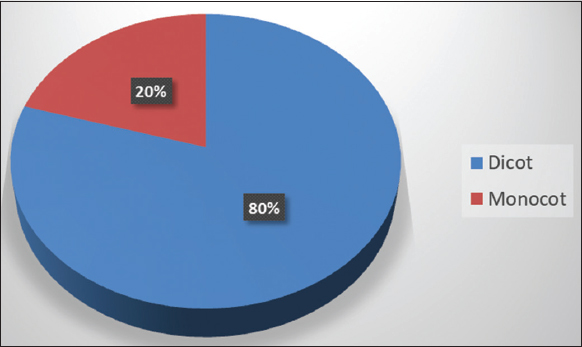 | Figure 1: Graphical representation of dicot and monocot in study sites. [Click here to view] |
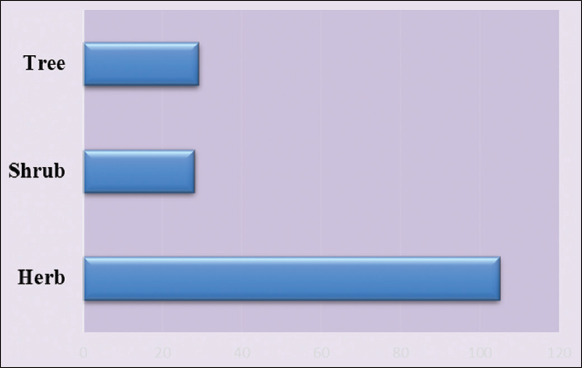 | Figure 2: Graphical representation of Herbs, Shrubs and Trees in study sites. [Click here to view] |
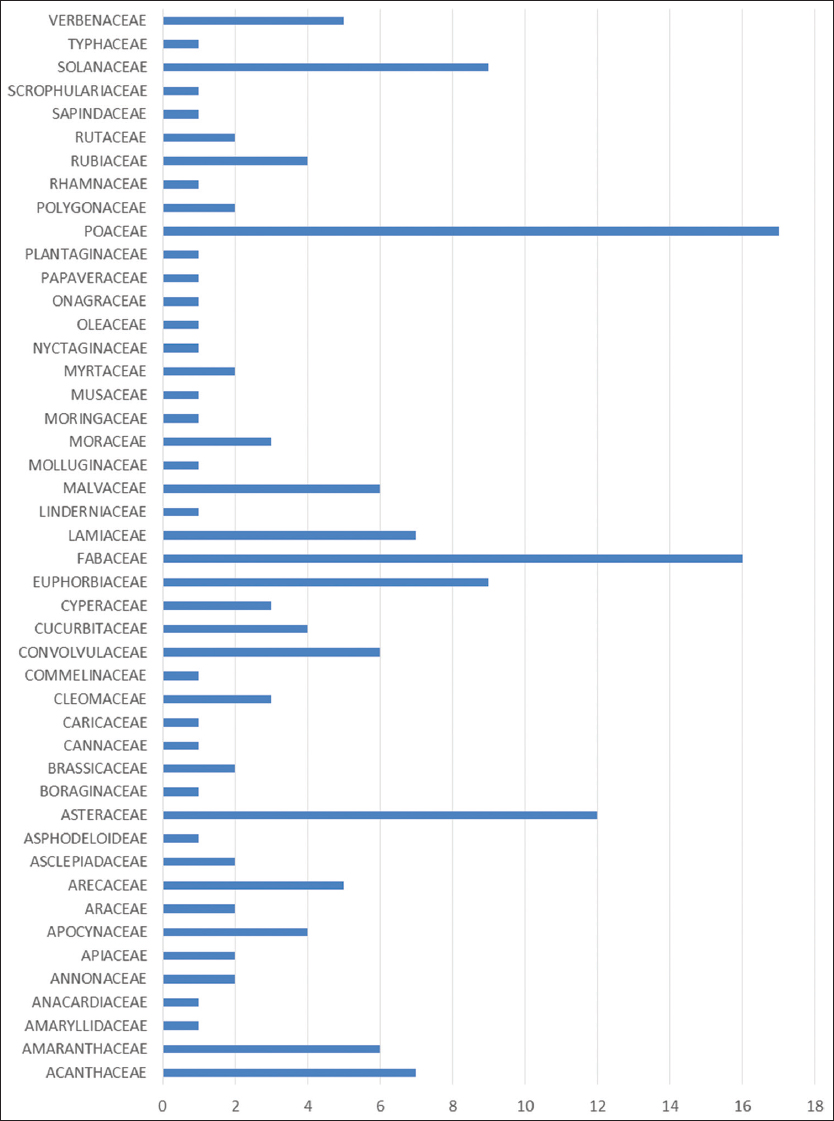 | Figure 3: Graphical representation of Family wise species number. [Click here to view] |
 | Figure 4: Plant communities of different study sites of Lower-Gangetic Plains along Katwa and Kalna stretch. [Click here to view] |
Floristic diversity should be assessed at both local and regional levels to provide information on the present status necessary for developing an effective conservation management strategy [21]. Aquatic and wetland angiosperms are exceptional plant types that sustain the livelihoods of millions residing in their vicinity [16]. The work is entirely based on primary sources, focusing on the utilization of locally accessible plants by tribal communities as home remedies. The documentation of flora is essential for the study of riverine ecology and faunal research, as several plant species exhibit direct or indirect interdependence [22]. The ecological integrity of any river ecosystem is directly related to the integrity of the plant communities that make up and surround the river catchments and their ecological characteristics [23-25].
4. CONCLUSION
The study elucidates the richness and distribution of plant species present in the Lower Gangetic Plain. Diverse plant groups exist along the banks of the Ganga River in this area. The region functions as a dynamic and diversified mixed ecosystem, playing a crucial role in sustaining the equilibrium between aquatic and terrestrial habitats. These locations function as homes for a diverse array of flora and allied organisms, all of which depend on the availability of water and the distinctive environmental conditions present in these places.
5. AUTHOR CONTRIBUTIONS
All authors made substantial contributions to conception and design, acquisition of data, or analysis and interpretation of data; took part in drafting the article or revising it critically for important intellectual content; agreed to submit to the current journal; gave final approval of the version to be published; and agree to be accountable for all aspects of the work. All the authors are eligible to be an author as per the International Committee of Medical Journal Editors (ICMJE) requirements/guidelines.
6. FUNDING
There is no funding to report.
7. CONFLICTS OF INTEREST
The authors report no financial or any other conflicts of interest in this work.
8. ETHICAL APPROVALS
This study does not involve experiments on animals or human subjects.
9. DATA AVAILABILITY
All the data is available with the authors and shall be provided upon request.
10. PUBLISHER’S NOTE
All claims expressed in this article are solely those of the authors and do not necessarily represent those of the publisher, the editors and the reviewers. This journal remains neutral with regard to jurisdictional claims in published institutional affiliation.
11. USE OF ARTIFICIAL INTELLIGENCE (AI)-ASSISTED TECHNOLOGY
The authors declare that they have not used artificial intelligence (AI)-tools for writing and editing of the manuscript, and no images were manipulated using AI.
REFERENCES
1. Sarkar AK, Mazumder M. A surveillance to evaluate the diversity, dominance and community structure of tree species in Nagrakata forest beat, Chalsa forest range, West Bengal, India. Int J Pure Appl Biosci. 2016;4(5):133-43. [CrossRef]
2. McNeely JA. Forest biodiversity at the ecosystem level:Where do people fit in? Unasylva. Spec Issue For Biol Divers. 1991;53(2):10-5.
3. Mazumder M, Sarkar AK. Ecological status of angiospermic macrophytes in retension ponds and drainage ditches of Jalpaiguri District, West Bengal, India. Indian Forester. 2020;146(3):226-34. [CrossRef]
4. Ehrlich PR, Wilson E. Biodiversity studies:Science and policy. Science. 1991;253:758-62. [CrossRef]
5. Dey M, Sarkar AK. Plant assemblages within and adjacent to protected areas of Adina Deer Park (Forest), Malda, West Bengal, India. Bull Env Pharmacol Life Sci. 2021;10(12):162-87.
6. Sarkar AK. Ecological studies of tree vegetation of Ramshai forest range, Gorumara National Park. Int Res J Biol Sci. 2016;5(7):53-9.
7. Das GK. River systems of West Bengal - a review. Indian Sci Cruiser. 2023;37(2):11-24. [CrossRef]
8. Singh LP, Parkash B, Singhvi AK. Evolution of the lower Gangetic plain landforms and soils in West Bengal, India. Catena. 1998;33(2):75-104. [CrossRef]
9. Mani MS. Ecology and Biogeography in India. Dordrecht:Springer;1974. [CrossRef]
10. Roy R, Maity M, Manna S. Study of soil and vegetation characteristics in the lower Gangetic plains of West Bengal. Res J Pharm Biol Chem Sci. 2017;8(3):1558-68.
11. Naskar K, Guha Bakshi DN. Mangrove Swamps of the Sundarbans:An Ecological Perspective. Kolkata:Naya Prakash;1987.
12. Singh R, Singh GS. Integrated management of the Ganga river:An ecohydrological approach. Ecohydrol Hydrobiol. 2020;20(2):153-74. https://doi.org/10.1016/j.ecohyd.2019.10.007 [CrossRef]
13. Prasad KN, Shivamurthy GR, Aradhya SM. Ipomoea aquatica, an underutilized green leafy vegetable:A review. Int J Bot. 2008;4(1):123-9. [CrossRef]
14. Mazumder M, Sarkar AK. Ethnobotanical survey of indigenous leafy vegetables consumed in rural areas of Terai-Dooars region of West Bengal, India. J Threat Taxa. 2019;11(12):14612-8. [CrossRef]
15. Prain D. Bengal Plants. Vol. 1 and 2. Kolkata:Botanical Survey of India;1903.
16. Das D, Mondal S, Mandal S. Studies on some economically important aquatic plants of Katwa subdivision of Burdwan district, West Bengal. Int J Curr Microbiol Appl Sci. 2016;5(6):961-72.[CrossRef]
17. Dey M, Mazumder M, Sarkar AK, Ghosh S, Sarkar D, Rahaman R. Floristic composition and fodder availability in Patlakhawa forest patches under Cooch Behar forest division, West Bengal, India. NeBIO. 2020;11(3):220-33.
18. Das B, Mazumder M, Sarkar AK, Dey M. Weed composition in rice field agroecosystem of Terai-Dooars and northern plain of West Bengal, India. Int J Recent Sci Res. 2018;9(6):27375-81.
19. Sarkar AK, Mazumder M, Dey M. Weed species composition of pineapple based cropping system at Northern part of West Bengal, India. Adv Biores. 2017;(6):258-69.
20. Sarkar AK, Dey M, Mazumder M. Impact of non-timber forest products on forest and in livelihood economy of the people of adjoining areas of Jalpaiguri forest division, West Bengal, India. Int J Life Sci. 2018;6(2):365-85.
21. Jain SK, Rao RR. Dictionary of Indian Folk Medicine and Ethno-Botany. Vol. 1. New Delhi:Deep Publication;1977.
22. Smith JD. The Relationship between Riparian Zone Width and Floristic Quality in Shenandoah County, Virginia. [Masters Theses];2014.
23. Flotemersch JE, Leibowitz SG, Hill RA, Stoddard JL, Thoms MC, Tharme RE. A watershed integrity definition and assessment approach to support strategic management of watersheds. River Res Appl. 2016;32(7):1654-71. [CrossRef]
24. Parmar R, Purani K, Das L, Kamboj RD. Phytosociological study of riparian flora of Sabarmati river in Prantij Taluka of Sabarkantha District, Gujarat, India. Int J Creat Res Thoughts. 2021;9(4):5447-55.
25. Devi RS. Trees of Mahanadi river areas of Cuttack, Odisha:Part I. J Biodivers. Conserv. 2024;8(4):52-60.